
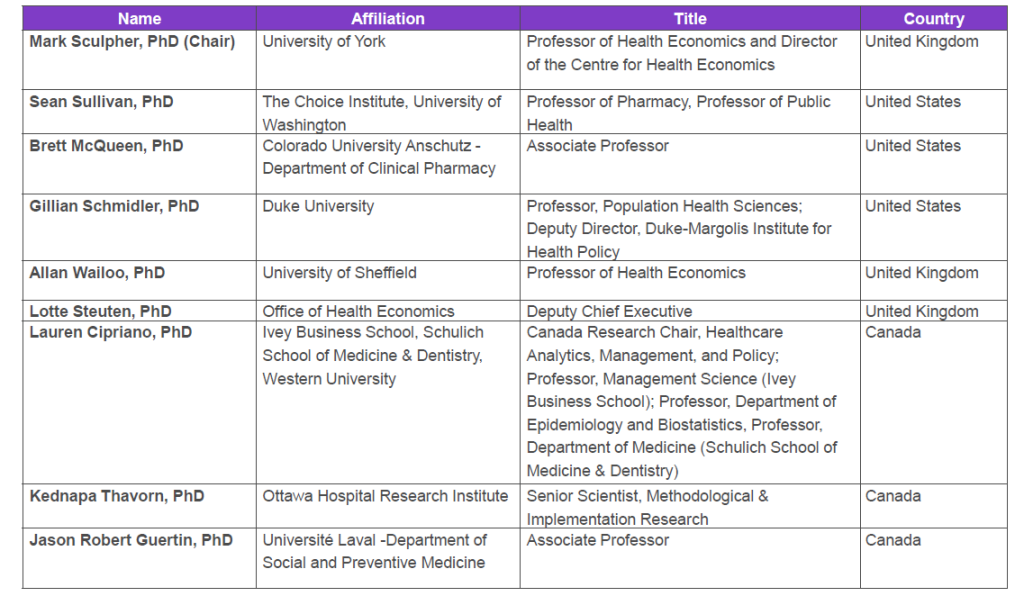
All HEMA Working Group member voluntarily disclose all financial and intellectual relationships that are relevant to HEMA’s work on an annual basis. The full Conflict of Interest Policy can be found below.
HEMA’s Policies for Managing Potential Conflicts of Interest
- HEMA Working Group members cannot receive a direct salary from a health care company.
- HEMA Working Group members must disclose whether they have published an examination of the current review topic in the last 36 months.
- If they have published on the current review topic, and that work was not funded by a health care company, they may still participate as a working group member in this review. This prior publication will become part of their COI disclosure.
- If the publication(s) in question was funded by a health care company, the HEMA Secretariat and the HEMA Working Group Chair will discuss ways to manage this COI, including possible recusal from all or part of the review.
- HEMA Working Group members must disclose any income from a health care company in the past 36 months.
- HEMA Working Group members must attest that if they collaborate with any third-party entity for composing feedback on a HEMA publication, they must inform the HEMA Secretariat of this collaboration.
Definitions
Health care company is defined as: Any life sciences manufacturer and/or life sciences association (for example, pharmaceutical, biotechnology, or medical device companies), or health plan, and/or health plan association, etc. Per our definition, this does not include hospitals, and/or academic institutions, and/or consultancies.
Income is defined as:
- Direct salary
- Consulting fees
- Stocks
- Intellectual property rights
- Royalties from intellectual property
- Loan or debt interest forgiveness
- Honoraria
- Gifts
- Expenses paid for travel, food, drink, or entertainment
- Research funding (grants and/or contracts)
HEMA Working Group members’ disclosures can be found below.
| HEMA Working Group Member | Conflict of Interest Disclosure |
| (Chair) Mark Sculpher, PhD, Professor of Health Economics, Director of the Centre for Health Economics, University of York | Dr. Sculpher has received consulting income from several companies including Abbvie, Astrazeneca, Argenx, MSD and Bayer. |
| Brett McQueen, PhD, Associate Professor, Colorado University Anschutz – Department of Clinical Pharmacy | Dr. McQueen received consulting income from Merck, Amgen, Genentech, Sanofi, and Stage Analytics. |
| Allan Wailoo, PhD, Professor of Health Economics, University of Sheffield – School of Medicine and Population Health | Dr. Wailoo has received consulting income from Axis Consulting, Sanofi and the ABPI in the last 36 months. |
| Lauren Cipriano, PhD Canada Research Chair in Healthcare Analytics, Management, and Policy; Associate Professor, Ivey Business School, University of Western Ontario | No conflicts to disclose. |
| Jason Robert Guertin, PhD, Associate Professor, Université Laval -Department of Social and Preventive Medicine | Dr. Guertin has received honoraria from Roche Canada and IQVIA Solutions Canada Inc. |
| Gillian Sanders Schmidler, PhD, Professor, Population Health Sciences, Duke University | Dr. Sanders-Schmidler received consultancy funding from Avertix in 2025. |
| Lotte Steuten, PhD, Deputy Chief Executive, Office of Health Economics | Dr. Steuten is an employee of the Office of Health Economics (OHE), a registered charity and Independent Research Organisation in the UK, which receives funding from a wide range of public and private sector sources for work on healthcare decision analysis and many other topics related to health economics and health policy. |
| Sean Sullivan, PhD, Professor of Pharmacy, Professor of Public Health, University of Washington | Dr. Thavorn participated in three advisory meetings in 2026 organized by Bristol Myers Squibb and Johnson & Johnson related to their cardiovascular products. |
| Kednapa Thavorn, PhD, Senior Scientist, Methodological & Implementation Research, Ottawa Hospital Research Institute | No conflicts to disclose. |